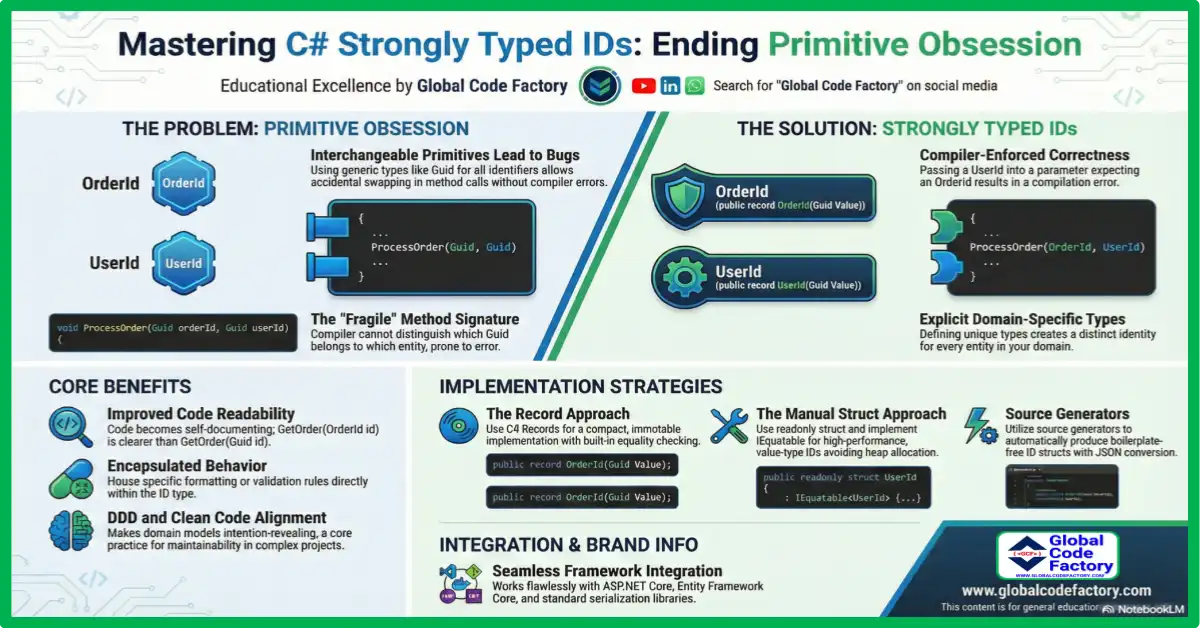
C# Strongly Typed IDs enhances the expressiveness and type safety of your program. They stops misuse of primitive IDs like Guid, int, or string across domain models. Your code becomes more reliable as a result.
What Are Strongly Typed IDs in C#?
Entity IDs are frequently represents primitive values like Guid, int, or string. But because these primitives are interchangeable, can lead to bugs, particularly when several ID types share an underlying type.
Instead of:
We define:
This method ensures that every ID is typed strongly and avoids confusion during compilation.
Why Use Strongly Typed IDs in C#?
Improve Type Safety: Swapped IDs are catches as errors by the compiler.
Improve Readability — Code becomes self-documenting with explicit types.
Encapsulate Behavior: Include formatting logic or validation within the ID type.
Additionally, Domain-Driven Design (DDD) works well with strongly typed IDs. They make models more intention-revealing while solving primitive obsession.
Implementation Examples of C# strongly typed IDs
Manual Struct or Record Approach
Struct (mutable-safe, value-type):
Record (compact, immutable):
Use Source Generators for Boilerplate-Free IDs
You can use custom C# source generators or tools like StronglyTypedId to avoid writing redundant code:
This generates type-safe ID structs with comparability, parsing, JSON conversion, and more.
A Brief Overview of Benefits
- Use compile-time safety to prevent ID misuse.
- APIs that are clean, such as GetOrder(OrderId id) rather than GetOrder(Guid id).
- Boilerplate-free with source generators.
- Functions flawlessly with EF Core, ASP.NET Core, and serialization.