Inheritance in C# is a key part of object-oriented programming.
It lets one class use the features of another class.
This helps in writing cleaner and more reusable code.
In addition, it helps keep things consistent across different parts of an application.
So, it’s really important for every developer to understand inheritance.
💡 Learn Visually:
The video above shows how Inheritance in C# works using simple and easy-to-follow examples.
What Is Inheritance in C#?
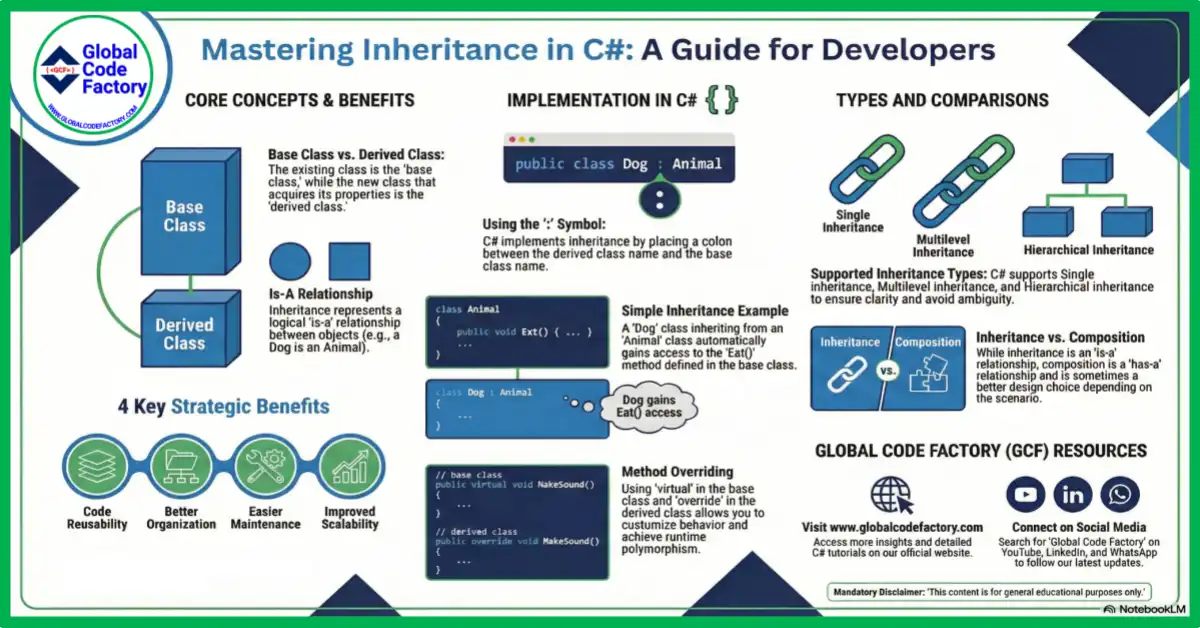
- Inheritance lets a class take on the properties and methods of another class.
- The original class is called the base class.
- The new class is called the derived class.
- This makes it easier to reuse code.
- It also makes it simpler to add new features to an application.
Why Inheritance Is Important?
- Inheritance helps solve a lot of design problems.
- It helps reduce repeated code.
- It makes maintenance easier.
- It also helps with adding new features.
- Because of this, developers can improve a program without breaking the old parts.
Key benefits include:
- Code reusability.
- Better organization.
- Easier maintenance.
- Improved scalability.
How Inheritance Works in C#?
- In C#, you use the colon symbol (:) to create it.
- The derived class extends the base class.
- This means it can use all the accessible members of the base class.
Example: Simple Inheritance
In this example, the Dog class inherits from the Animal class.
So, the Dog can use the Eat method from the Animal class.
Types of Inheritance
- C# supports a few types of inheritance.
- But, it doesn’t allow a class to inherit from more than one class.
- Instead, interfaces can be used for that kind of behavior.
Supported Types
- Single inheritance.
- Multilevel inheritance.
- Hierarchical inheritance.
Because of this, C# makes things clear and avoids confusion.
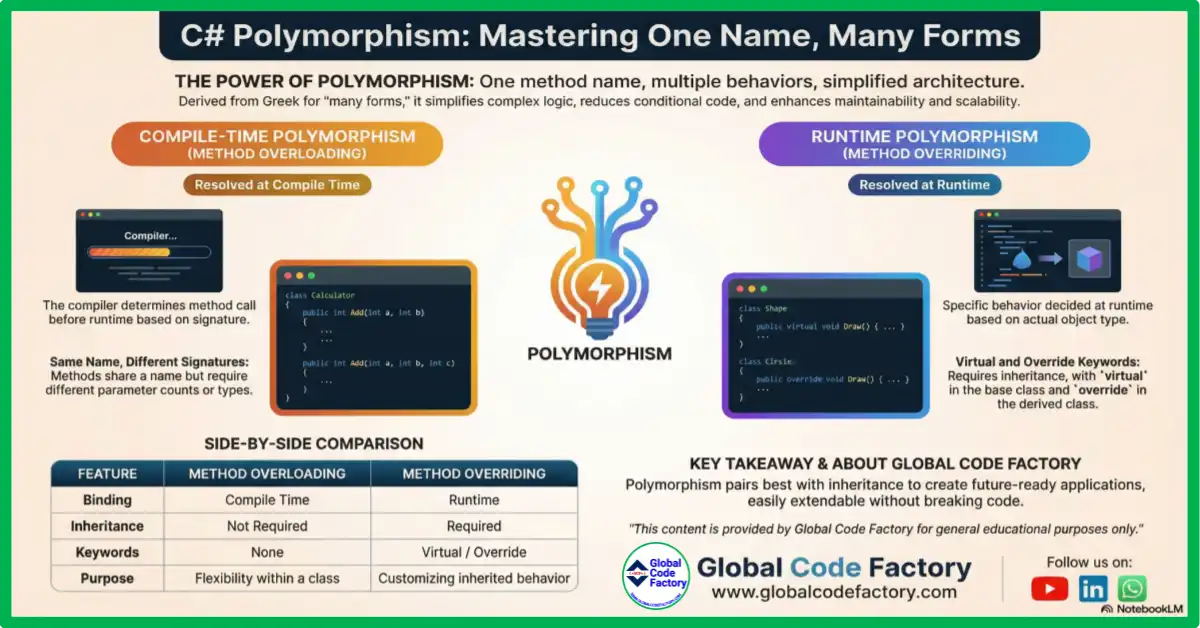
Method Overriding in Inheritance
- Method overriding lets a derived class change how a method behaves in the base class.
- It uses the virtual and override keywords.
- This helps achieve runtime polymorphism.
Example: Method Overriding
In this example, the Car class changes the way the Start method works.
This makes inheritance more powerful.
Inheritance vs Composition (Quick Note)
- Inheritance shows an is-a relationship.
- Composition shows a has-a relationship.
- Although inheritance is useful, composition can be better in some cases.
- So, it’s important to make good design decisions.
Key Takeaways
- Inheritance in C# helps reuse code.
- It uses base and derived classes.
- C# supports single, multilevel, and hierarchical inheritance.
- Method overriding adds flexibility.
- Inheritance is a main part of OOP.
Frequently Asked Questions (FAQ)
What is inheritance in C#?
- Inheritance lets a class reuse the members of another class.
- It helps create clean and maintainable code.
Does C# support multiple inheritance?
- C# doesn’t support multiple class inheritance.
- But, you can use interfaces to get similar behavior.
What keyword is used for inheritance in C#?
- C# uses the colon symbol (:).
- It connects the derived class to the base class.
When should inheritance be used?
- Inheritance should be used when there is an is-a relationship.
- Otherwise, composition is usually a better choice.